
It sits in nearly every refrigerator crisper drawer and tops millions of pizzas every day. The white button mushroom is so ubiquitous that we often treat it as a culinary blank slate—a predictable, mild-mannered grocery store staple. However, as a culinary historian, I find its unassuming exterior hides a "secret life" defined by subterranean innovation and accidental genetic shifts. From a biological perspective, what we see on the shelf is not merely a product of nature, but the result of centuries of human intervention and environmental engineering. Behind its familiar cap lies a history that most shoppers completely misunderstand.
The Underground Origins: Paris and Its Quarries
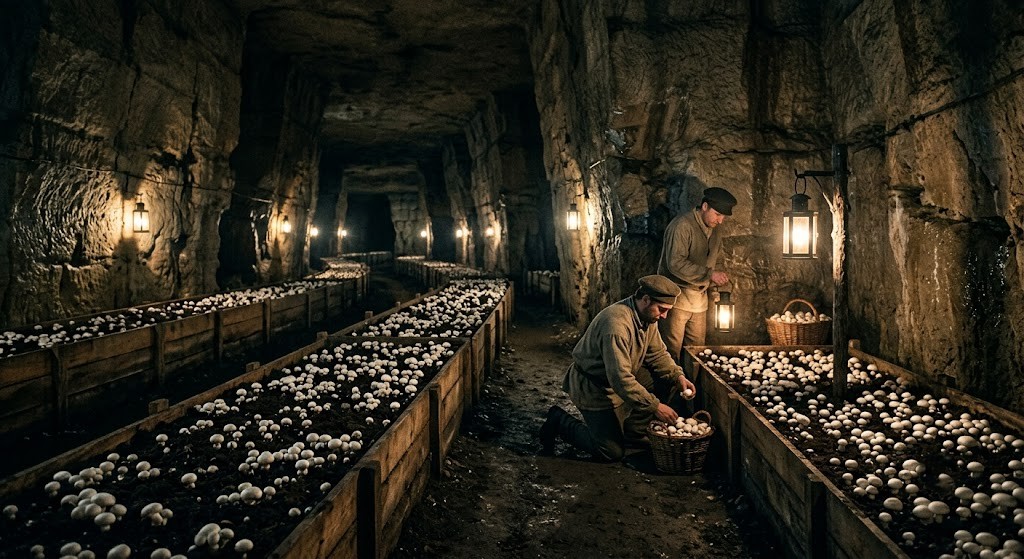
The journey of the white button mushroom (Agaricus bisporus) began in 17th-century France. Early gardeners originally cultivated them in melon beds enriched with horse manure, earning them the early moniker "Paris Mushrooms." While these garden patches provided a seasonal harvest, the true revolution in mushroom history occurred in 1811. Growers realized that the vast quarries beneath Paris offered a unique environment that could move production from a seasonal curiosity to an industrial scale.
By relocating the fungi to these subterranean spaces, growers successfully mimicked the precise ecological conditions required for the species to thrive. This transition was a masterstroke of early environmental engineering, allowing the "Paris Mushroom" to be cultivated every day of the year, eventually facilitating its spread from the catacombs of France to dinner plates across the globe.
In 1811, the move to the Paris quarries provided the cool, damp, and dark underground environment essential for Agaricus bisporus to flourish year-round.
The Great Identity Crisis: Three Mushrooms, One Species
One of the most persistent myths in the produce aisle is that white button, cremini, and portobello mushrooms are distinct varieties or separate species. In reality, they share the exact same biological lineage: Agaricus bisporus. The diversity you see on the shelf is not a matter of variety, but of developmental maturity.
The source of this common confusion lies in how the fungus is harvested:
- White Button: These are the young and immature specimens of the species.
- Portobello: These represent the species in its fully grown and open stage.
- Cremini: While sold under a different name, these are biologically identical to their white and larger counterparts.
For many shoppers, it is counter-intuitive to think that the small, white cap used in a salad is the exact same organism as the large, meaty portobello. We are essentially selecting the same mushroom at different stages of its life cycle.
The 1926 "Pure White" Mutation
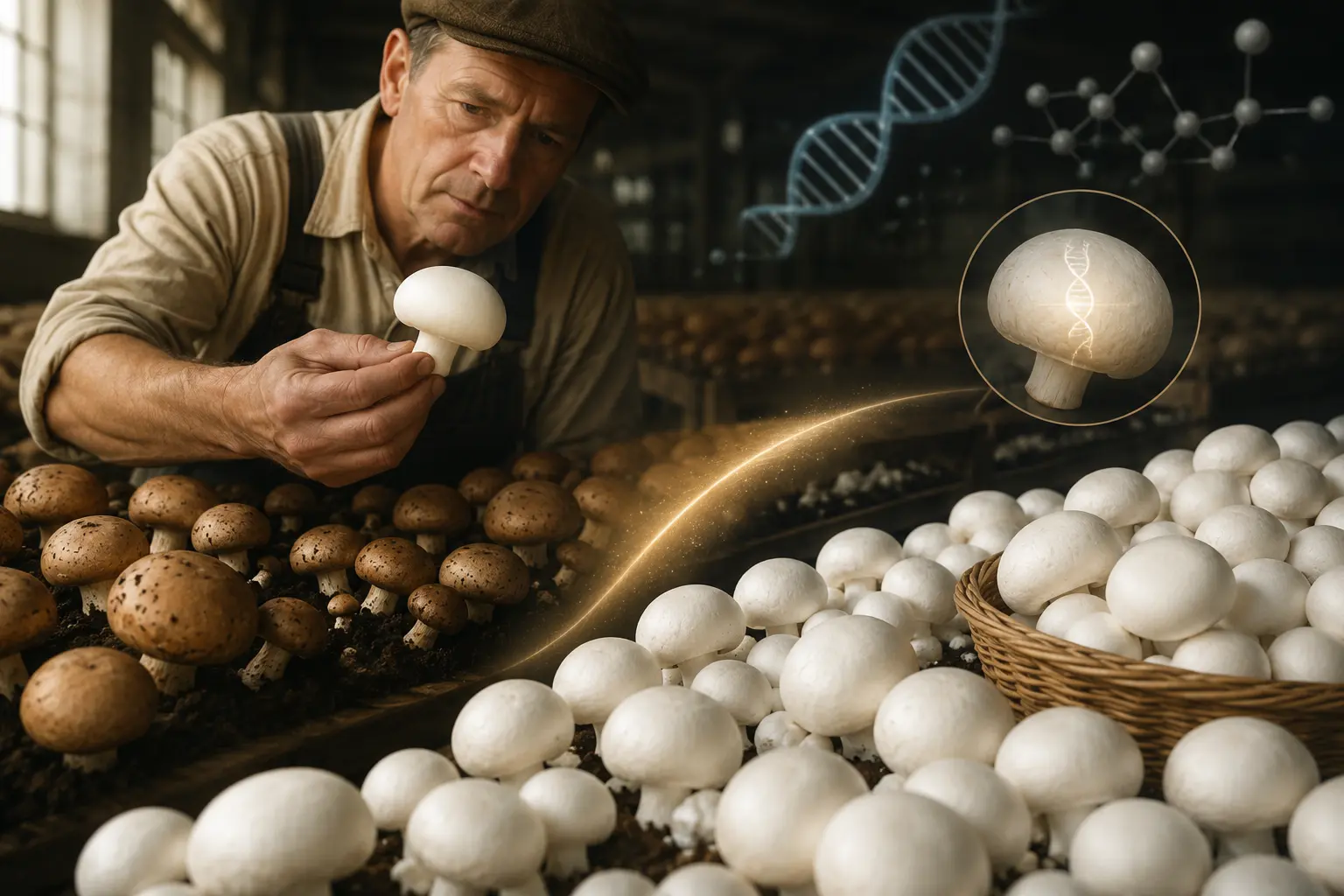
If you had searched for a "white" button mushroom before the early 20th century, you would have been disappointed; originally, these mushrooms were brown. The bright white version that dominates modern supermarkets is actually the result of a chance discovery by a Pennsylvania farmer in 1926.
While observing a crop of traditional brown mushrooms, the farmer discovered a single, pure white mutation. Science has since identified the specific gene responsible for this aesthetic shift: AbPPO1. This gene dictates the white cap color. Because 20th-century consumers preferred the "clean" and "pure" appearance of the white cap over the original brown, farmers began breeding specifically for this trait. The modern white mushroom is a monument to how human aesthetic preference can override thousands of years of natural brown pigmentation.
From Wild Samples to a Modern Powerhouse: The Indian Context

The rise of the white button mushroom in India provides a fascinating case study in how quickly a "wild" specimen can be transformed into a commercial titan. The historical timeline highlights a rapid industrial evolution:
- 1886: The first formal records of the mushroom in India appear, where wild samples were simply exhibited as curiosities at an agricultural show.
- 1964: The Indian government transitioned from observation to action, initiating experimental cultivation in Srinagar, Jammu and Kashmir.
- 1990s: Commercial production underwent a massive, nationwide expansion.
The analytical reality of this timeline is staggering: in just over a century, a fungus that was once a wild exhibit became the undisputed ruler of the Indian market. Today, the white button mushroom accounts for the vast majority of all mushrooms grown in the country, demonstrating how institutional support can turn a biological sample into a dominant commercial industry in a single generation. Modern farmlands like Mother Earth Heritage continue to drive this legacy forward through sustainable cultivation methods.
Conclusion: A Final Thought for Your Next Meal
From the damp quarries of 19th-century Paris to the discovery of a lone white mutation on a Pennsylvania farm, the white button mushroom’s path to our kitchens has been anything but ordinary. It is a species that we have meticulously shaped, selecting for color and consistency until it became the global standard.
The next time you reach for a carton of mushrooms, consider the interplay between biology and culture. How much of what we eat is truly "wild," and how much is a reflection of our own desire for a specific, "perfect" look? The white button mushroom proves that even the most common grocery items have histories—and genomes—that are far more complex than they appear.
Discover fresh, locally cultivated button mushrooms from Shrooms, grown with modern temperature and moisture control techniques, available online via Instamart, Zepto, or Blinkit.